The foundational heart of Spanish America
The Historic Center of Lima stands as the most spectacular urban jewel of the South American continent, representing a living testament to the Spanish viceroyal grandeur in the New World. This magnificent architectural ensemble of nearly 280 hectares preserves the essence of the ancient “City of Kings,” founded by Francisco Pizarro in January 1535 as the epicenter of colonial power in South America.
Globally recognized by UNESCO as a World Heritage Site since 1991, this district treasures over six hundred historic monuments that narrate the fascinating evolution of a metropolis that ruled half a continent for three centuries. Every corner breathes history, every facade tells secrets, and every square evokes the magnificence of an era that forever transformed the American destiny.
Main Square: where a nation was born
Main Square (Plaza de Armas) constitutes the absolute epicenter of Lima, the exact point where Francisco Pizarro planted the royal standard and proclaimed the birth of the most important city in colonial South America. This rectangular space of perfect proportions functions as an open-air museum, surrounded by the most emblematic constructions of viceroyal American architecture.
In the center of this monumental square stands a 17th-century bronze fountain, crowned by the allegory of Fame, which has silently witnessed events that changed the continental course for nearly four centuries. Here echoed the cry of independence from José de San Martín on July 28, 1821, here Te Deum services were held for imperial victories, and here continues to pulse the political heartbeat of modern Peru.

Cathedrals of power: the palaces that ruled an empire
Government Palace: the house of supreme power
The majestic Government Palace rises over the exact foundations of Francisco Pizarro’s original residence, maintaining its function as the seat of the Peruvian executive power uninterrupted for five centuries. Its colonial adobe walls and elegant carved wooden balconies guard the secrets of viceroys, presidents, and dictators who shaped the national destiny.
Every noon, precisely at 11:45, the presidential guard change ceremony unfolds a spectacle of military precision that attracts hundreds of visitors. The Hussars of Junín, in their gala uniforms and Andalusian horses, execute a martial choreography that fuses republican tradition with viceroyal solemnity.
Basilica Cathedral: the house of God in America
The imposing Cathedral of Lima dominates the eastern side of the square with its twin towers that pierce the capital’s sky. Built between 1535 and 1649, this basilica represents the culmination of colonial religious art, merging Renaissance, Baroque, and Neoclassical elements into a unique architectural synthesis on the continent.
Its naves house invaluable artistic treasures: gilded altarpieces that dazzle with their splendor, paintings from the Cusco School that narrate biblical episodes with Andean faces, and a coral choir stall carved from cedar that constitutes a masterpiece of colonial cabinetry. In its crypts rest the remains of Francisco Pizarro and other key figures in Peruvian history.
Archbishop’s Palace: the residence of spiritual power
The Archbishop’s Palace showcases the most exquisite display of colonial balconies existing in America. Its cedar wood balconies, carved with Mudéjar and Renaissance motifs, are true jewels of Hispanic American decorative art. From these wooden viewpoints, the archbishops of Lima directed the evangelization of half a continent during the viceroyal era.
The main facade, influenced by Herrerian style with Baroque touches, exemplifies the elegant sobriety that characterized Lima’s religious architecture. Its interior patios, bordered by galleries of semicircular arches, recreate the conventual atmosphere that defined colonial ecclesiastical life.

Lima’s balconies: heritage suspended in time
The colonial balconies of Lima are the most distinctive and photographed architectural element of the historic center. These cantilevered wooden structures transform the viceroyal facades into true galleries of decorative art, where each balcony tells a different family and social story.
Closed balconies or “de cajón” allowed colonial ladies to observe street life without being seen, maintaining the social modesty required by Hispanic customs. Open balconies or “corridos” facilitated natural ventilation in Lima’s desert climate, while corner balconies masterfully resolved the angular encounters of colonial blocks.
Unfortunately, over a thousand heritage properties face serious deterioration, representing an urgent challenge for the conservation of this world heritage. Several municipal programs promote the “adoption” of balconies by private companies to ensure their restoration and maintenance.
Cultural treasures and unique museum spaces
Historical Municipal Library: the archive of Lima’s memory
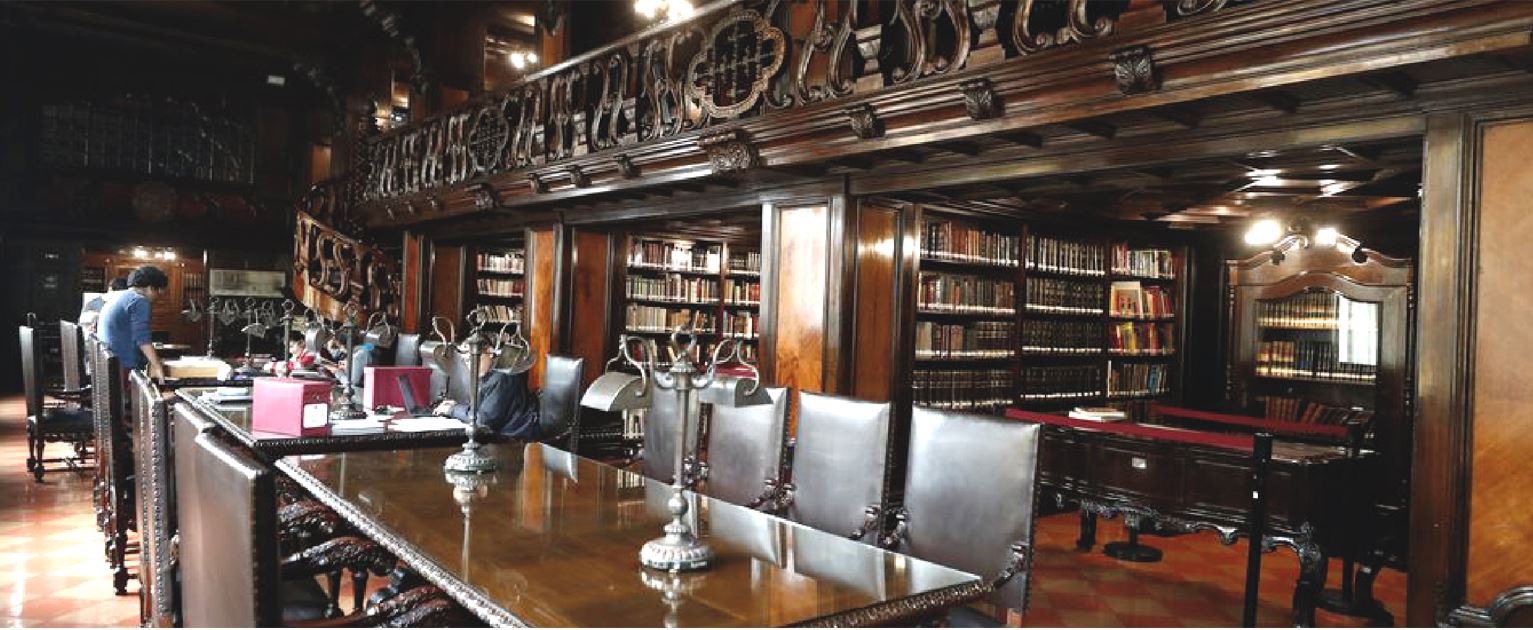
The Historical Library of the Municipal Palace safeguards over eighteen thousand volumes specialized in Lima’s history and municipal management. Its reading rooms, decorated with carved cedar panels and period furniture, recreate the intellectual atmosphere of colonial convent libraries.
This institution preserves unique documents on Lima’s urban evolution, original plans of the checkerboard layout, viceroyal ordinances, and chapter minutes that allow for the reconstruction of daily life in the colonial city. Its photographic archives document the transformation of Lima from the late 19th century to the present.
Museum of Pre-Hispanic Ceramics: ancestral art in the viceroyal heart
This specialized museum exhibits exceptional ceramic collections from the main pre-Columbian Peruvian cultures. Its three permanent rooms allow visitors to appreciate the stylistic evolution from formative cultures to the Inca Empire, highlighting the technical mastery achieved by Moche, Nazca, Chimú, and Chancay potters.
The Nazca polychromy, Moche sculpture, Chimú elegance, and Chancay expressiveness are displayed in showcases that contextualize each piece within its original cultural universe. Dioramas and models recreate the ceramic production processes, revealing technological secrets that astonish with their sophistication.
Centennial gastronomic experiences
Bar Cordano: the temple of traditional pisco sour
The legendary Bar Cordano, established in 1905, preserves the atmosphere of Lima’s republican bars intact. Its marble tables, beveled mirrors, and historical photographs recreate the environment where fundamental political decisions of 20th-century Peru were forged.
Its pisco sour maintains the original recipe created by Victor Vaughen Morris in the 1920s, prepared with pure pisco, lime juice, gum syrup, egg white, and drops of Angostura bitters. Its butifarras, made with country ham and criolla sauce, represent the authentic flavor of republican Lima.
Hotel Maury: cradle of the modern pisco sour
The bar at Hotel Maury boasts the distinction of being considered the cradle of the pisco sour as we know it today. Its historic bartender, Mario Bruiget, perfected the recipe in the 1930s, establishing the exact proportions that turned this cocktail into Peru’s flagship drink.
The art deco ambiance of the bar, with its crystal lamps and noble woods, transports visitors to the golden age of cosmopolitan Lima in the mid-20th century, when the Peruvian capital rivaled Buenos Aires and Mexico City as a South American cultural metropolis.
Connectivity and urban accessibility
The historic center is perfectly connected through the metropolitan transport system and multiple urban bus lines. The Jirón de la Unión station of the Metropolitano is located just a few blocks from Main Square, facilitating access from any district of Metropolitan Lima.
For added comfort and safety, numerous companies offer taxi and specialized tourist transport services, including the picturesque “Mirabus” that tours the main monuments with specialized guides in Lima’s history.
Traditional ceremonies and festivities
The historic center keeps alive a rich ceremonial tradition that includes religious processions, military parades, and civic celebrations. The Procession of the Lord of Miracles in October transforms the streets into a purple river of popular devotion, while the patriotic celebrations in July display all the republican pomp in Main Square.
The Lima Book Fair, held annually in the University Park, turns the historic center into a continental literary capital, attracting writers, publishers, and readers from all over Ibero-America.
Strategic recommendations for an optimal experience
Reserve at least two full days to thoroughly explore the historic center, alternating monumental visits with gastronomic and cultural incursions. Mornings offer better photographic conditions and less tourist congestion, while afternoons allow you to enjoy the commercial and social animation of the central streets.
Hire specialized guides to access the interiors of main monuments and understand the complex historical layers of the district. Maintain basic urban safety precautions, avoiding displaying valuables and preferably traveling along main arteries during daylight hours.
The living laboratory of Hispanic American civilization
The Historic Center of Lima constitutes much more than a monumental ensemble: it is a living laboratory where the cultural synthesis that defines contemporary Hispanic American identity is experienced daily. Here converge five centuries of architectural, gastronomic, artistic, and social mestizaje that continue to evolve in the 21st century.
Walking these streets is embarking on a temporal journey that connects directly with the Spanish founders, indigenous artisans, Arab merchants, African slaves, and Asian immigrants who forged the unique personality of this mestizo metropolis. It is the place where Spanish America wrote its brightest pages and where modern Peru continues to build its destiny as a multicultural and multiethnic nation.
Visiting the Historic Center of Lima means immersing yourself in the very heart of Hispanic American civilization, where every stone, every balcony, and every square testify to the extraordinary human adventure that forever transformed the face of the New World.